The question nearly everyone is facing is how to adopt AI in financial crime models in a way that genuinely changes cost, control and outcomes.
Too many firms are stuck between uncontrolled experimentation and heavy governance. There are sandboxes, pilots and impressive demos, but little is live and taking pressure out of BAU. Meanwhile, criminals are operationalising AI at speed, making manual operating models harder to defend.
Our view is that AI can – and must – change the cost and performance curve for AML and other areas of Financial Crime prevention. But that will only happen when it is engineered into the operating model and governed with discipline.
On this page you’ll find useful information about implementing AI in Financial Crime teams, including AML, KYC and fraud functions.
This includes guidance on how it should be implemented across first – and second-line FinCrime teams, along with a number of practical articles, a glossary, links to relevant documents, and FAQs.
If you're part of the first line, we know that you are under sustained pressure to reduce cost while maintaining effective control. In the meantime, AI activity is increasing across KYC, screening and transaction monitoring.
Too often, what's missing is the measurable impact of AI in production.
Pilots drift, and benefits are described in productivity terms but do not translate into resourcing change. AI is being layered onto existing workflows, rather than redesigning them with AI at the heart.
To remove cost, you need:
With the proper plans in place, building AI into financial crime operating models is about changing the resourcing footprint and building a leaner, more scalable model over time.
Experimentation with AI is already underway across most Financial Crime functions – sometimes formally sponsored, sometimes not.
At the same time, supervisory expectations are tightening. Model risk, explainability, accountability and oversight are under scrutiny. AML and AI obligations are beginning to converge.
The second line needs clarity and control. If AI is introduced, it must strengthen the control environment – not create unmanaged risk.
That requires:
Defined governance triggers and materiality thresholds.
Integrated AML and AI oversight within one coherent framework.
Clear documentation, monitoring and validation standards before go-live.
A defensible roadmap you can confidently explain to regulators and your board.
Alignment between cost reduction and risk effectiveness – so cost does not simply move between lines of defence.
The objective should not be to slow progress, but instead enable disciplined, regulator-ready AI adoption that delivers both cost efficiency and control credibility.
A briefing note for banks, insurers and Lloyd’s syndicates on new compliance obligations and their impact on financial crime, risk and customer operations.

You do not need perfect data or a fully redesigned architecture before starting to implement AI in financial crime models.
Waiting for ideal foundations often delays progress indefinitely. The more practical question is whether you can introduce AI safely, in a tightly scoped use case, with governance and oversight designed from the outset. Foundations improve faster when AI is being used deliberately.
Because pilots are not being engineered into the operating model when it comes to implementing AI in financial crime and AML models.
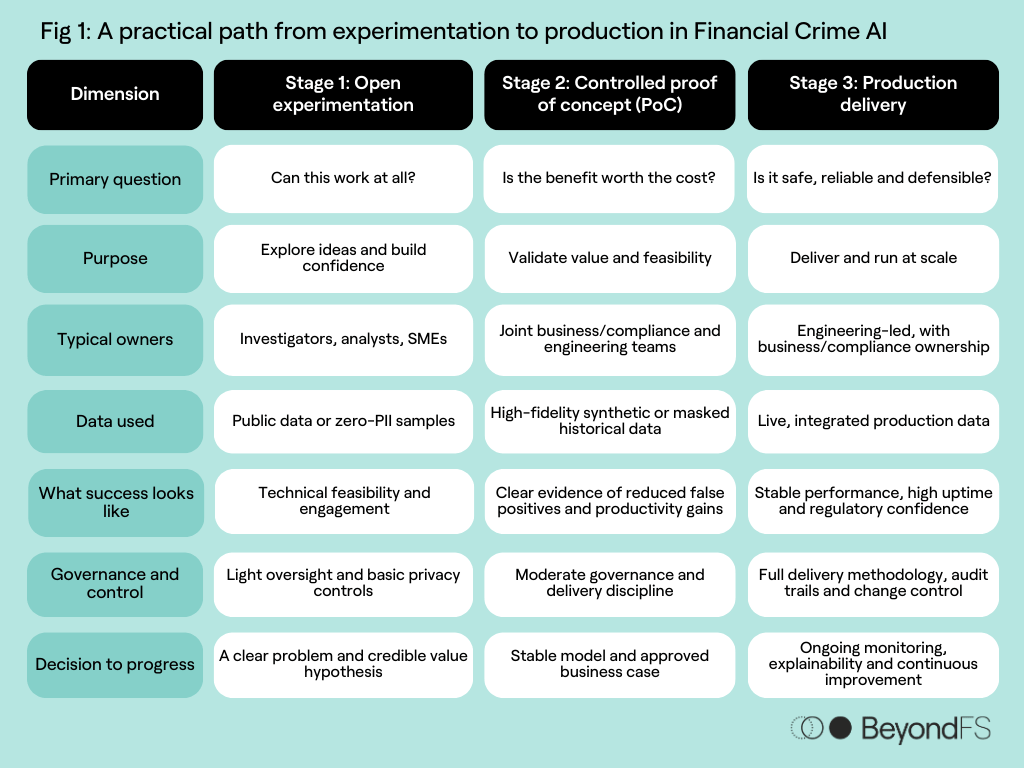
Many pilots demonstrate technical capability but never alter workflow, ownership or resourcing. Without clear production criteria, defined benefits and engineering involvement early on, promising ideas drift in what we call 'pilot purgatory'. Scaling requires discipline: measurable objectives, governance triggers, and a defined route into BAU.
AI must sit within one coherent AML control framework. That means clear materiality thresholds, defined triggers for formal review, documented validation standards, and ongoing monitoring in BAU. If AI improves first line throughput but increases second line review burden, cost has simply moved. Done properly, AI should strengthen – not dilute – the control environment.
AI in financial crime models can deliver significant impact in high-volume, judgement-heavy activities with clear pain points.
Alert triage, elements of KYC refresh, adverse media screening, and investigative support are common starting points. The focus should be on use cases that remove meaningful workload and can be evidenced through measurable operational change.
There is no universal answer.
Some firms move faster by adopting vendor tools while building internal capability. Others prefer stronger in-house control from the outset. The key is orchestration: designing an ecosystem of tools and agents that work together, rather than accumulating disconnected point solutions.
If you need support moving from AI experimentation to scalable, production-grade deployment, we can help.
Our clients turn to us instead of the ‘big 4’ because of our deep expertise in delivering financial crime change programmes. Get in touch today to find out more.
Director at BeyondFS
Roger is a senior transformation leader with 20 years’ experience delivering technology and data change on Financial Crime programmes, including AI-enabled technologies, with many global FIs and smaller institutions.
roger.tudor@beyondfs.co.uk